 Founderizer
An OpenClaw alternative, compared honestly. Both run AI agents on hardware you own, for different jobs.
OpenClaw is a free, open-source assistant that lives in your chat apps. Founderizer is a paid, maintained fleet of agents with roles, on servers and Macs you own. Both can use the Claude plan you already pay for. This page compares them on what a buyer weighs, and says where OpenClaw is the better choice.
Who wrote this: Founderizer, which sells Founderizer and is not affiliated with OpenClaw or the OpenClaw Foundation. It is the one page on this site that names another product (why). Every statement about OpenClaw links to OpenClaw’s own README or documentation, as they read on 8 November 2026, when its latest release was v2026.11.1. If one is wrong or out of date, write to support@founderizer.com and the page will be corrected.
Side by side
Compared on what you would weigh: what each one is and costs, where it runs, which models, where you talk to it, work it does unasked, asking you first, access and the record, updates, calling home, and help.
| OpenClaw | Founderizer | |
|---|---|---|
| What it is | An open-source AI assistant that runs on your own computer and meets you in the chat apps you already use. One Gateway runs it, as a personal assistant on a laptop or shared by several people. (README) | A maintained product: a hub, a manager and agents with roles, on machines you own, with a Mac app and an iPhone app. |
| Licence and price | MIT. Stewarded by the OpenClaw Foundation, an independent 501(c)(3), with no paid tier, hosted service or token. (README, licence) | €79 a month or €790 a year, plus VAT, after 14 days free. The hub’s code is public under FSL-1.1-ALv2: source-available, not open source. |
| Where it runs | macOS, Linux and Windows. Its FAQ recommends a VPS for round-the-clock work, with at least 1 vCPU, 1 GB of RAM and about 500 MB of disk. (README, FAQ: providers and hosting) | A hub on an Ubuntu or Debian server, agents on servers or on Macs that stay on, and the Mac app on your own Mac. A €5 VPS is enough to begin with. |
| Models | Claude, Codex and local models, as plugins you can swap. For Claude, an Anthropic API key billed per use, or an existing Claude Code login on the same machine. (README, Anthropic) | Claude first, signed in on each machine through Anthropic’s own sign-in, on the plan you already pay for. Codex is allowed; Grok is not supported. |
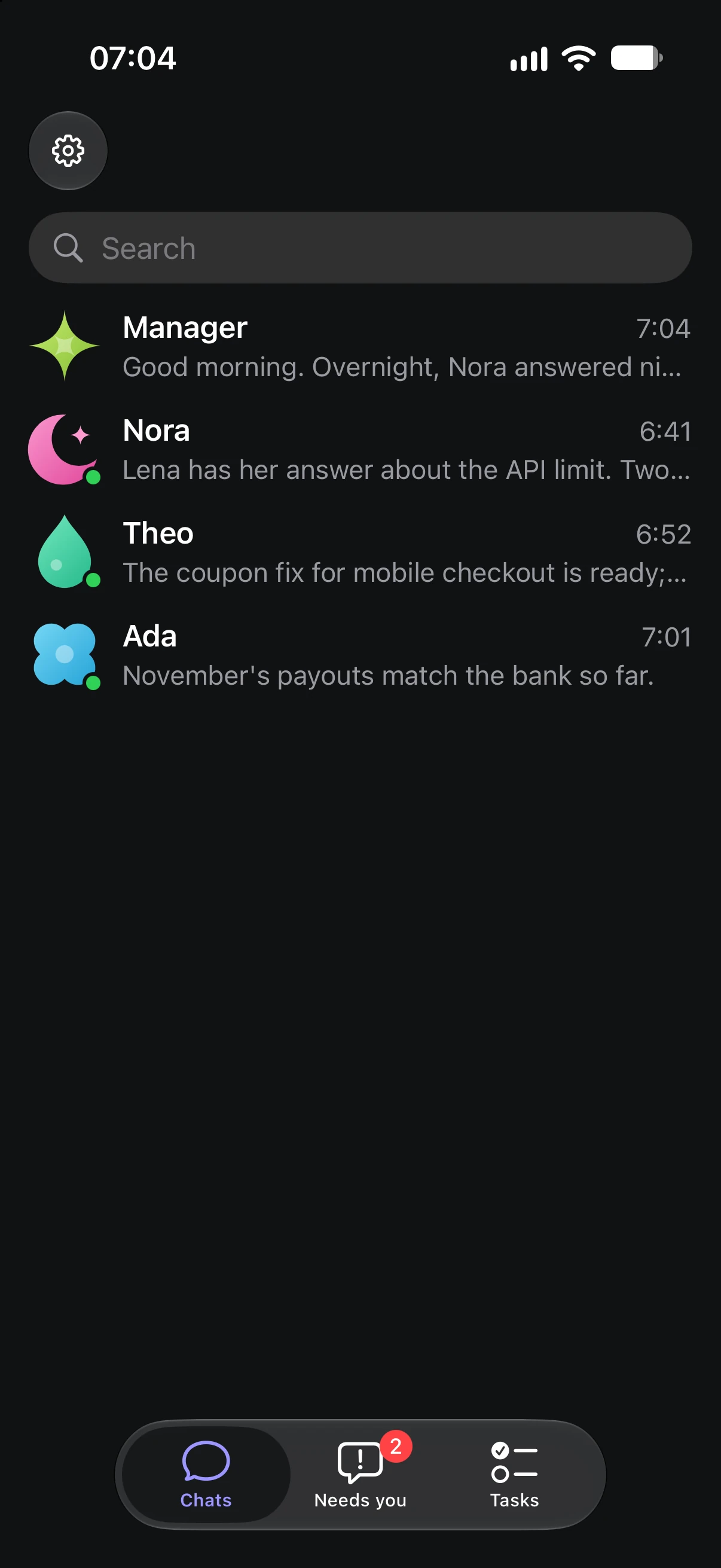
| Where you talk to it | Discord, iMessage, Slack, Teams, Telegram, WhatsApp and more than twenty others, plus apps for macOS, iOS, Android, Windows and Linux. (README) | The Mac app, and the iPhone app by TestFlight invitation. |
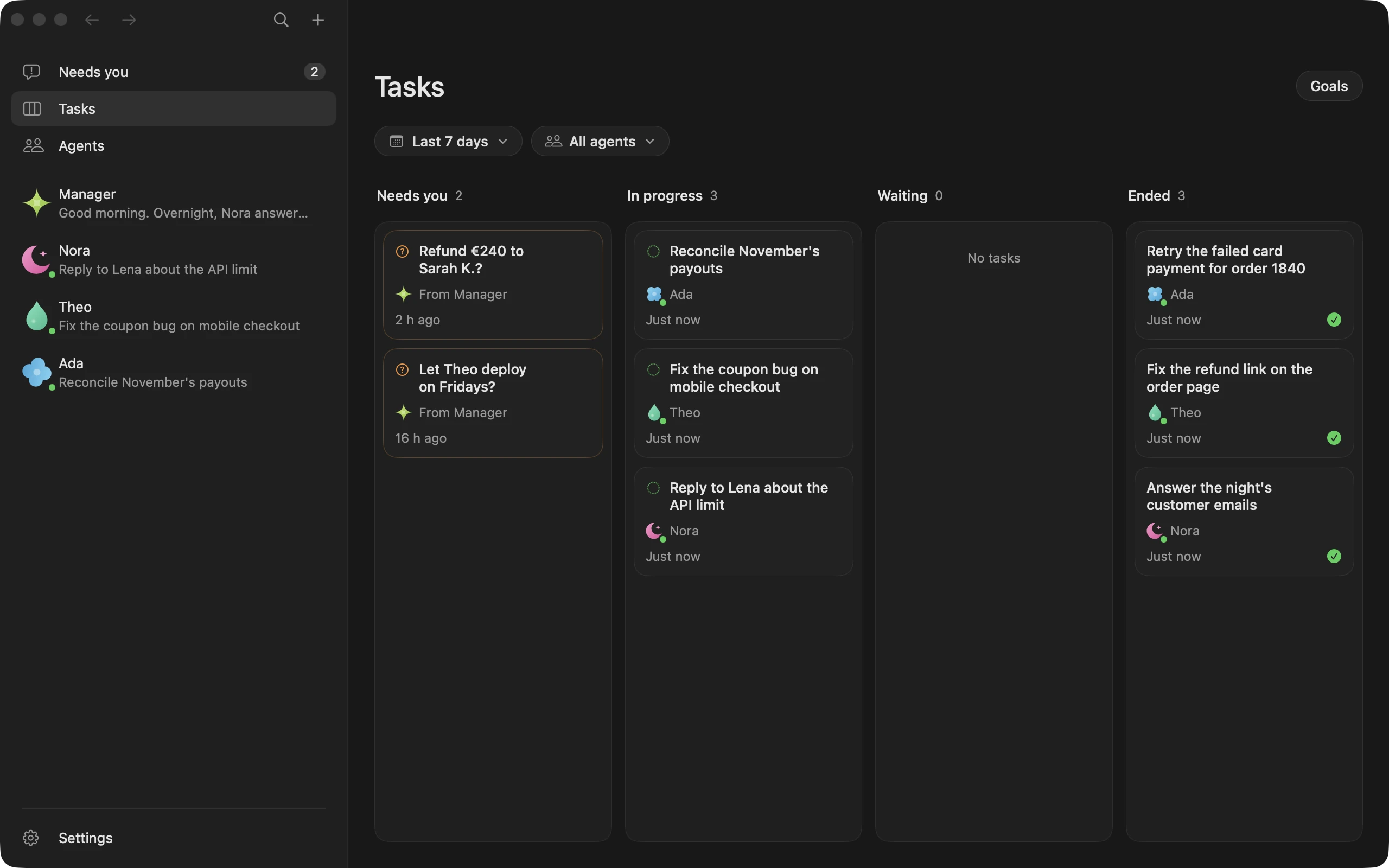
| Work it does unasked | A built-in scheduler keeps jobs, wakes the agent on time, and can send the result to a chat, a webhook or nowhere. (automations) | Each agent has a role and standing duties it keeps without being asked, and the manager gives out the rest of the work. |
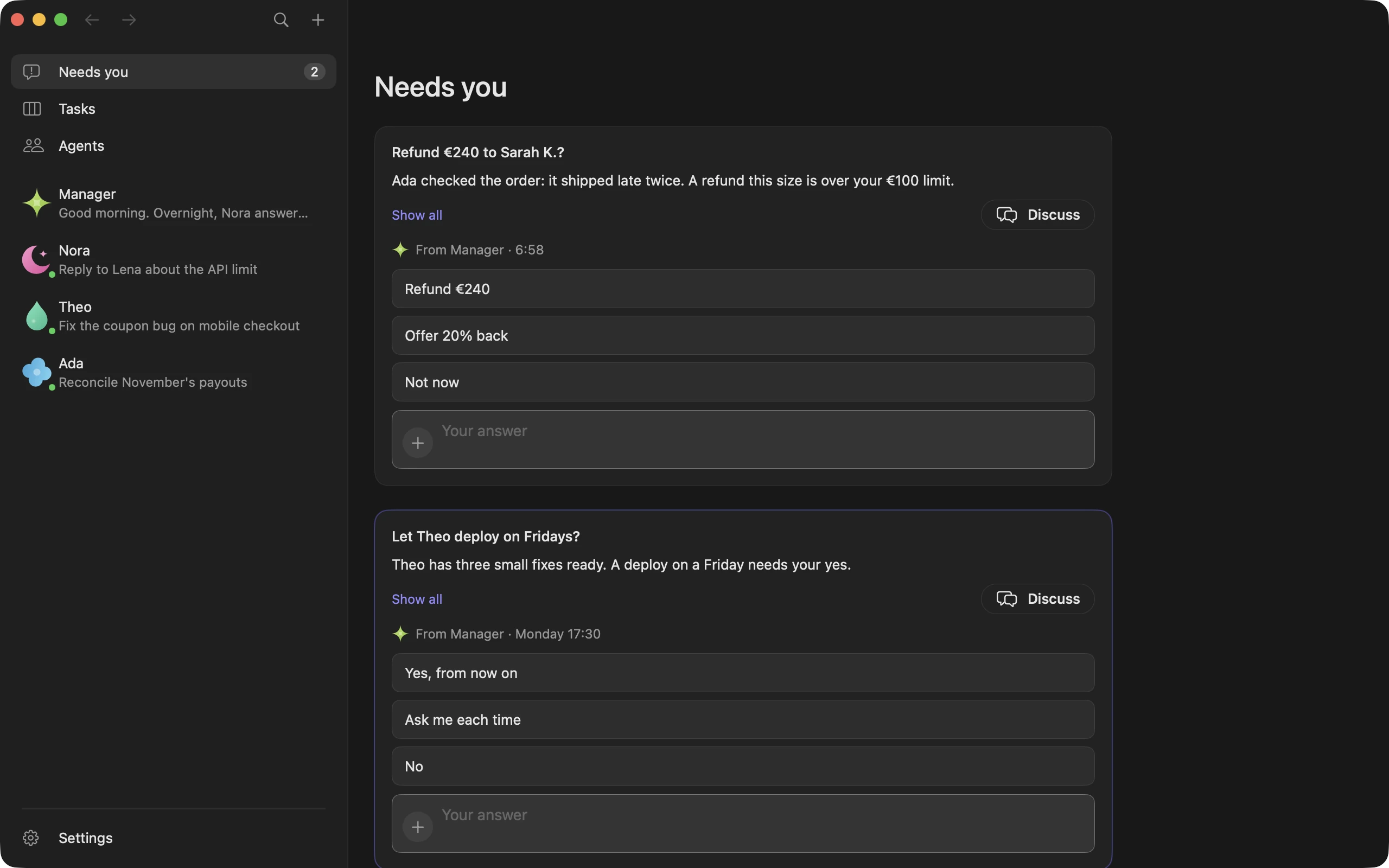
| Asking you first | Exec approvals: a command runs only when policy, an allowlist and an optional approval agree, and the approval prompt can go to Slack, Discord or Telegram. (exec approvals) | Anything an agent may not do by itself becomes a question under Needs you, answered from the Mac or the iPhone. |
| Access and the record | State, memory and credentials stay on your hardware. Tools run on the host for the main session unless you set up sandboxing, and the docs recommend keeping the agent’s workspace in a private git repository as a backup. (README, agent workspace) | Logins sit in a vault on your hub’s server, where no agent runs, and each agent gets one grant at a time. Every grant and every owner decision is a git commit you can read and revert. |
| Updates | The project ships releases — v2026.11.1 on 5 November 2026. Headless nodes and managed Gateway services can update automatically, and the docs describe automatic rollback and verified backups. (releases, automatic updates, rollback and recovery) | We publish releases. Your hub takes one when it is idle, checks itself, and returns to the version it pinned if a check fails. If you cancel, the updates stop and the fleet keeps running. |
| Calling home | By default, only a daily version check. Anonymous feature statistics are opt-in, and one setting turns both off. (README) | No licence check, no call home, no expiry. A heartbeat of version numbers and check results only if you switch it on. |
| Help | GitHub issues, community.openclaw.ai and Discord. (README) | Email, read by the person who builds it, with no promised response time. |
What Founderizer looks like
Screenshots of the Mac app and the iPhone app, on an example fleet.
Setting it up
OpenClaw
One line installs it — a curl script on macOS, Linux or WSL2, or a PowerShell line on Windows — and opens an onboarding wizard that checks model access, creates the workspace and configures the Gateway. Then you connect the chat apps you want. (README, getting started)
Founderizer
Three steps. Start the 14 free days at Stripe, and one button opens the Mac app with your key. In the app, connect Tailscale and a server — Hetzner or DigitalOcean from one token, or any VPS by its address — then sign in to your Claude plan. The manager writes to you first, and a QR code adds your iPhone.
What it costs to run
No figure here is a guess. OpenClaw’s come from its README and FAQ; ours from the pricing page and the figures the rest of this site already states.
| OpenClaw | Founderizer | |
|---|---|---|
| The software | Nothing: MIT, with no paid tier. (README) | €79 a month or €790 a year, plus VAT, after 14 days free. |
| The machine | Yours. A laptop adds no server cost but sleeps; for round-the-clock work the FAQ recommends a VPS with at least 1 vCPU and 1 GB of RAM. (FAQ: providers and hosting) | Yours: a small server, about €5–20 a month by our own figure, and the Mac the app runs on. |
| The model | An Anthropic API key billed per use, or your Claude plan through Claude Code — or another provider, or a local model. (Anthropic, README) | The Claude plan you already pay for. Codex is allowed. |
| The network | Your choice. The README asks you to read the security guide and the exposure runbook before you expose the Gateway remotely. (README) | Tailscale. Its free plan is for personal use; business use needs its Standard plan, $8 a user a month. |
| Your time | You install, secure and update it, with the project’s docs and community. (README) | We keep it current. The machine, the backups and every grant stay yours. |
Which one is yours
OpenClaw is better when
- You want free, open-source software and no subscription.
- You want the assistant in the chat apps you already use — WhatsApp, Telegram, Slack, Discord, iMessage and many more.
- You want to choose the model: an API key, another provider, or a model that runs on your own machine.
- You do not use a Mac, or you want apps on Android, Windows or Linux.
- You want a large community, and the skills and plugins it has already written.
- You are happy to install, secure and update it yourself.
Founderizer may suit you better when
- You want a product somebody maintains for a fee, with a Mac app and an iPhone app, rather than a project to run.
- You want several agents with roles across machines you own, and their logins in a vault on a hub where no agent runs.
- You want every grant and every owner decision to be a git commit you can read and revert.
- You want each decision that is yours to reach your phone as a question, with who raised it and when.
- You work on a Mac, with Claude.
If you want an assistant in your chat apps, free, on whatever computer you have, choose OpenClaw. If you want a maintained fleet of agents with roles on machines you own, a git record of every grant, and the decisions that are yours on your phone — on a Mac, with Claude — that is what Founderizer is for, at €79 a month after 14 days free.
Questions
Is OpenClaw free?
The software is: its README says it is MIT-licensed, with no paid tier, hosted service or token. You still pay for the model use, and for a server if you want it running round the clock. (README)
Do both use my Claude plan?
They can. OpenClaw’s docs describe two routes for Claude: an Anthropic API key, billed per use, or an existing Claude Code login on the same machine, which draws on that plan’s limits — and they call the API key the better choice for shared automation or predictable production spend. (Anthropic) Founderizer signs each machine in to the plan you already pay for, through Anthropic’s own sign-in, and never holds the credential. Either way, the limits are reached on your account.
Can I try Founderizer before paying?
14 days free. Stripe takes the card at the start and charges nothing until the free days end.
How this page was written
These pages describe the product as its own code and terms describe it. Where a page compares Founderizer with another way of working, it compares the way of working, not a named product’s current plan. One page is the exception. People look for an alternative to OpenClaw by name, so the owner approved one page that names it, on 8 November 2026. It takes every fact about OpenClaw from OpenClaw’s own README and documentation, links each one, and says the day they were checked.
OpenClaw’s own pages that this one cites, as they read on 8 November 2026:
- github.com/openclaw/openclaw#readme
- github.com/openclaw/openclaw/blob/main/LICENSE
- docs.openclaw.ai/help/faq-first-run/providers-and-hosting
- docs.openclaw.ai/providers/anthropic
- docs.openclaw.ai/automation/cron-jobs
- docs.openclaw.ai/tools/exec-approvals
- docs.openclaw.ai/concepts/agent-workspace
- github.com/openclaw/openclaw/releases
- docs.openclaw.ai/install/updating/automatic-updates
- docs.openclaw.ai/install/updating/rollback-and-recovery
- docs.openclaw.ai/start/getting-started
What makes an AI agent self-hosted is the checklist to hold either one to. What it costs and what you carry before you pay. Disagree with a line here? support@founderizer.com.